Jharkhand Election Results 2024
Introduction
The November 2024 Jharkhand Assembly Elections marked a significant chapter in the state’s political landscape. As Jharkhand completed its fifth assembly election since its formation in 2000, this electoral exercise reflected both established patterns and emerging shifts in the state’s complex socio-political fabric. With 81 assembly constituencies at stake, the battle for power in this resource-rich but economically challenged state carried substantial implications for regional and national politics.
Electoral Results: The Numbers That Shaped Jharkhand’s Future
The final tally of the 2024 Jharkhand Assembly Elections revealed a decisive mandate with the following seat distribution :

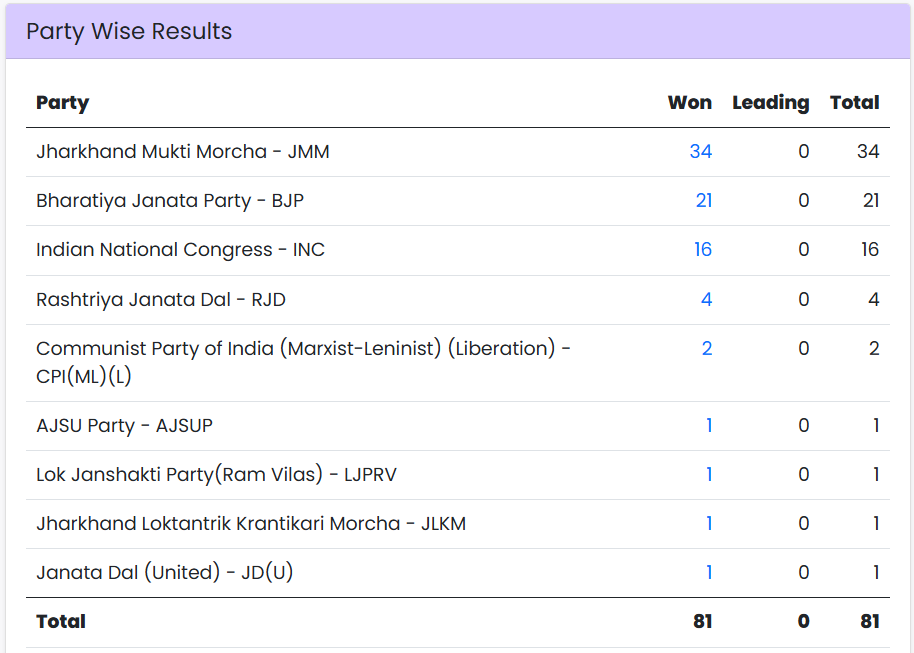
Jharkhand Mukti Morcha (JMM) : 34 seats
Bharatiya Janata Party (BJP) : 21 seats
Indian National Congress (INC) : 16 seats
Rashtriya Janata Dal (RJD) : 4 seats
Communist Party of India (Marxist-Leninist) Liberation : 2 seats
All Jharkhand Students Union Party (AJSUP) : 1 seat
Loktantrik Janshakti Party (Rashtriya Vikas) : 1 seat


These results demonstrate that the INDIA Alliance, comprising JMM, Congress, and RJD, secured a comfortable majority with 54 seats in the 81-member assembly, well above the required 41-seat threshold. This represents a strengthening of their position compared to the 2019 elections, indicating increased voter confidence in the alliance’s governance over the past five years.
Historical Context of Jharkhand Politics
Jharkhand’s political journey has been characterized by shifting alliances and changing voter preferences since its formation. Created in November 2000 after being carved out from Bihar, the state has witnessed governance by multiple parties including the BJP, JMM (Jharkhand Mukti Morcha), and coalition governments. The tribal population, constituting nearly 26% of the state’s demographics, has historically been a decisive factor in electoral outcomes.
The 2019 assembly elections had resulted in the JMM-Congress-RJD alliance forming government with Hemant Soren as Chief Minister, displacing the previous BJP administration under Raghubar Das. The 2024 election results reinforce this political realignment, with the alliance not only retaining but strengthening its position in the state legislature.
Key Electoral Issues in 2024
The 2024 assembly elections were fought on several crucial platforms:
1. Tribal Rights and Identity Politics: Protection of tribal land rights through CNT (Chota Nagpur Tenancy Act) and SPT (Santhal Parganas Tenancy Act) remained central to political discourse. The JMM’s overwhelming success with 34 seats suggests that their messaging on tribal identity and rights resonated strongly with voters.
2. Economic Development and Employment: With Jharkhand facing challenges of unemployment and migration, job creation promises featured prominently in campaign narratives. The election results indicate that voters favored the JMM-led alliance’s economic vision and employment initiatives.
3. Mining and Natural Resources: The management of the state’s mineral wealth and ensuring equitable distribution of benefits to local communities emerged as a contentious issue. The significant support for left-leaning parties including CPI(ML)(L) with 2 seats reflects ongoing concerns about resource allocation and labor rights.
4. Agricultural Distress: Farmer welfare and agricultural development policies received significant attention from all political contenders. The rural voting patterns, as reflected in the diverse seat distribution, suggest varied responses to agricultural policies across regions.
5. Infrastructure Development: Roads, electricity, water supply, and healthcare infrastructure became key battlegrounds for competing visions. The BJP’s retention of 21 seats indicates that their infrastructure development narrative maintained appeal in certain constituencies despite overall losses.
Vote Share Analysis and Demographic Patterns
The election results reveal important insights about voting patterns across Jharkhand:
JMM’s Consolidation: With 34 seats, JMM has significantly expanded its footprint beyond traditional tribal strongholds, indicating broader acceptance of its governance model.
BJP’s Urban-Rural Divide: The BJP’s 21 seats predominantly came from urban and semi-urban centers, suggesting stronger appeal in developed areas while losing ground in rural constituencies.
Congress Renaissance: The INC’s 16 seats mark a notable recovery compared to previous elections, indicating successful rebuilding efforts and effective alliance coordination.
RJD’s Limited But Crucial Presence : With 4 seats, RJD continues to maintain influence in regions with significant migrant populations from neighboring Bihar.
Left Representation : CPI(ML)(L)’s 2 seats reflect continued relevance of left ideology in mining and industrial belts with strong labor union presence.
Regional Parties’ Challenges: The single seat each for AJSUP and LJPRV highlights the increasing difficulty for smaller regional parties to maintain distinct identities amid bipolar political competition.
Major Alliance Dynamics
The electoral contest primarily featured two major alliances:
1. INDIA Alliance: Led by Jharkhand Mukti Morcha (JMM) with Congress and RJD as principal partners, representing the incumbent government. With a combined strength of 54 seats (JMM: 34, INC: 16, RJD: 4), this alliance has secured a strong mandate for continued governance.
2. National Democratic Alliance (NDA): Spearheaded by the Bharatiya Janata Party (BJP) with support from smaller regional parties. With BJP securing 21 seats and AJSUP winning 1, the alliance’s combined tally of 22 seats places it firmly in opposition.
The CPI(ML)(L) with 2 seats and LJPRV with 1 seat represent independent political forces that could play crucial roles in specific policy decisions despite not being formal alliance members.
Regional Voting Patterns
The election results demonstrate distinct regional variations:
Santhal Pargana Region: The JMM’s overwhelming performance in this tribal heartland contributed significantly to their 34-seat tally, maintaining their traditional dominance.
Kolhan Division: The mixed results here, with both JMM and BJP securing seats, reflect the urban-rural divide and complex tribal-non-tribal demographic interactions.
Chotanagpur Plateau: The BJP and Congress showed stronger performance in this region, with development and urbanization playing key roles in voter decisions.
Palamu Region: The diverse political representation in this region, including seats for RJD and smaller parties, highlights its distinct socio-political character.
Voter Turnout and Participation
The 2024 elections witnessed notable voter enthusiasm across Jharkhand’s diverse regions. The Election Commission implemented comprehensive measures to ensure peaceful and fair voting, particularly in Naxal-affected areas. Women voters continued their trend of high participation, often exceeding male turnout in several constituencies.
Digital initiatives like voter awareness campaigns on social media and mobile applications helped engage younger voters, resulting in improved participation from first-time voters compared to previous elections. Remote tribal areas that had historically seen lower participation showed encouraging increases in voter turnout.
Implications for Government Formation and Governance
With the INDIA Alliance securing 54 seats in the 81-member assembly, the path to government formation is straightforward. This comfortable majority provides several advantages:
1. Governance Stability: The alliance’s significant majority promises stable governance without dependence on smaller parties or independents.
2. Policy Continuity: The electoral mandate enables continuation and expansion of flagship welfare schemes and tribal protection initiatives.
3. Ministerial Allocation: The internal distribution of ministerial berths will likely reflect the proportional strength of alliance partners (JMM: 34, Congress: 16, RJD: 4).
4. Opposition Dynamics: With 21 seats, the BJP remains a strong opposition force capable of providing effective democratic checks and balances.
Impact on State Governance
The election results have set the stage for the next phase of governance in Jharkhand with several important implications:
1. Policy Continuity: The mandate suggests voter approval for existing policies regarding tribal rights, mining leases, and welfare schemes, indicating these will continue with potential expansions.
2. Center-State Relations: With the INDIA Alliance strengthening its position in Jharkhand while different political alignment exists at the national level, the dynamics of center-state relations will be particularly significant for resource allocation and policy implementation.
3. Tribal Welfare Focus: The JMM’s dominant position with 34 seats ensures that tribal welfare and protection of indigenous rights will remain central to governance priorities.
4. Industrial and Economic Direction: The new government’s approach to investment, industrial policy, and employment generation will shape Jharkhand’s economic trajectory, with the electoral mandate providing confidence for long-term planning.
Future Political Implications
The 2024 Assembly Elections have set important precedents for Jharkhand’s political future:
1. Leadership Consolidation: The JMM’s impressive performance with 34 seats solidifies the leadership position of Hemant Soren and his political approach combining tribal identity politics with development narratives.
2. BJP’s Recalibration Challenge: With 21 seats, the BJP faces the task of recalibrating its strategy to regain lost ground, particularly in tribal regions where the party’s national development narrative did not fully resonate.
3. Congress Resurgence: The party’s 16-seat performance indicates successful rebuilding efforts and effective coalition politics, potentially positioning it for stronger roles in future electoral contests.
4. Left Relevance: The CPI(ML)(L)’s 2 seats despite limited resources highlight the continued relevance of left ideology in specific pockets, particularly mining and industrial areas.
Conclusion
The November 2024 Jharkhand Assembly Elections, resulting in JMM winning 34 seats, BJP 21, Congress 16, RJD 4, CPI(ML)(L) 2, and AJSUP and LJPRV 1 each, represent a crucial democratic exercise that has shaped the state’s governance trajectory for the next five years. The INDIA Alliance’s comfortable majority with 54 seats indicates voter confidence in their governance model combining tribal welfare, resource protection, and inclusive development.
As Jharkhand moves forward under this electoral mandate, the results will continue to influence governance approaches, policy priorities, and political alignments. For political observers, these election statistics offer valuable insights into the complex interplay of identity, development, and governance that characterizes Indian democracy at the state level.
The coming years will reveal how effectively the mandate translates into governance outcomes addressing Jharkhand’s persistent challenges of balanced development, resource management, and social inclusion while protecting its unique cultural and environmental heritage.